Dr. So Yoon Park welcomes leading Japanese aesthetic surgeons for an ELLISYS SENSE clinical seminar following the publication of her latest periorbital RF study
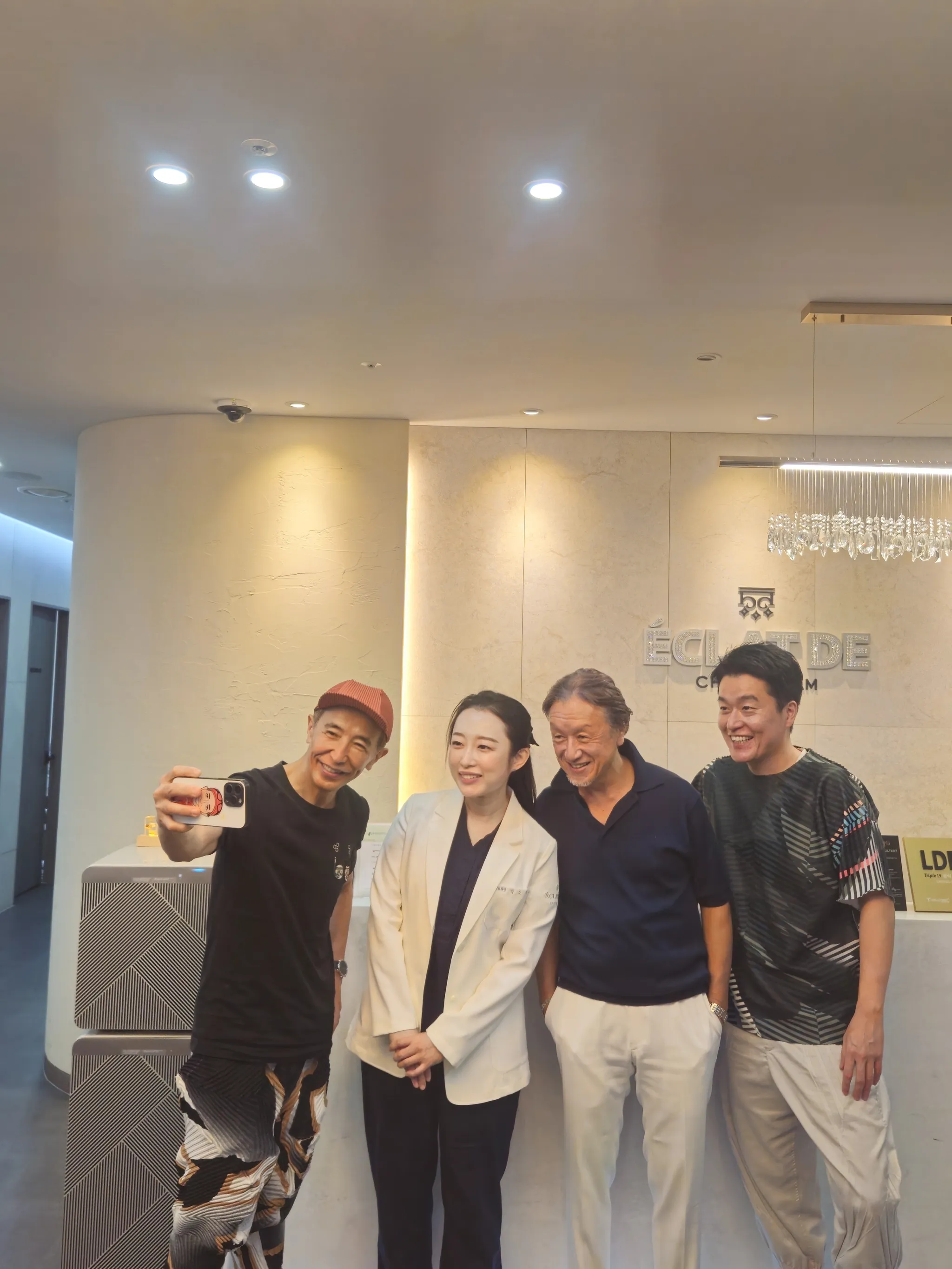
Éclat de Cheongdam Clinic recently had the pleasure of welcoming three distinguished physicians from Japan for a private ELLISYS SENSE clinical seminar and hands-on session led by Dr. So Yoon Park.
Our honored guests were:
Dr. Nobuyuki Masaki — Masaki Clinic
Dr. Keizo Fukuta — Chairman, Verite Clinic
Dr. Shinya Tsumiyama — Director, Verite Clinic Ginza
Their visit followed the publication of Dr. Park’s latest clinical research on the use of dual-depth, 25-pin insulated microneedle radiofrequency for moderate-to-severe periorbital wrinkles.
For Dr. Park, who has worked with ELLISYS SENSE since its earliest clinical introduction in Korea and continues to participate in international physician education as a Global Key Doctor, it was a particularly meaningful opportunity to bring published research back into the treatment room and share the details of her clinical experience directly with fellow physicians.
From a Published Paper to a Visit from Japan
In July 2026, Dr. So Yoon Park participated as a co-author in the study:
“Dual-depth 25-pin insulated microneedle radiofrequency for moderate-to-severe periorbital wrinkles.”
The research evaluated the efficacy and safety of ELLISYS SENSE for periorbital wrinkles and skin elasticity using a dual-depth 25-pin insulated microneedle RF protocol. Dr. Park and Éclat de Cheongdam Clinic are formally listed among the authors and participating institutions.
After learning about the publication and Dr. Park’s extensive clinical experience with ELLISYS SENSE, Dr. Masaki, Dr. Fukuta, and Dr. Tsumiyama visited Éclat de Cheongdam Clinic in Seoul to discuss the technique in greater depth and experience the treatment firsthand.
We were sincerely grateful that such respected colleagues traveled from Japan to spend this time with us.
What Is ELLISYS SENSE?
ELLISYS SENSE is a microneedle radiofrequency platform designed to deliver controlled RF energy directly into selected dermal depths.
The device can accommodate several needle configurations depending on the anatomical region and treatment objective. In the recently published periorbital study, a 25-pin insulated microneedle tip was selected specifically for the thin and delicate skin around the eyes.
The insulated shaft limits unnecessary thermal delivery along the length of the needle and concentrates RF energy predominantly near its exposed distal tip. This enables more selective thermal stimulation at the intended target depth.
While ELLISYS SENSE is already well known clinically for concerns such as enlarged pores, acne scars, and uneven skin texture, Dr. Park’s experience with the platform has evolved well beyond these traditional indications.
The recent publication is particularly meaningful because it provides clinical data supporting its application to another highly delicate area: periorbital wrinkles and reduced skin elasticity.

The Dual-Depth Double Shot Concept
One of the main topics discussed during the seminar was the Double Shot mechanism.
In the published protocol, RF energy was delivered sequentially at 1.5 mm and 1.0 mm depths during a single needle insertion cycle.
Vacuum-assisted fixation first stabilizes the tissue and maintains close contact between the handpiece and skin. The needles then enter the deeper preset level, where the first RF impulse is delivered. They subsequently reposition to the shallower level, allowing a second RF impulse to be delivered without requiring another complete mechanical insertion.
The schematic published in the paper illustrates this sequence step by step, from vacuum fixation to deep coagulation and subsequent superficial RF delivery.
This precise control of tissue contact, needle depth, and RF delivery is particularly relevant in areas such as the eyelids, where the skin is thin, mobile, and highly contoured.
What Did the Published Study Show?
The study included 32 adults between the ages of 30 and 60 with moderate-to-severe periorbital wrinkles.
Each participant received three treatments at four-week intervals, and outcomes were evaluated using blinded wrinkle grading, Antera 3D imaging, Cutometer measurements of skin elasticity, patient satisfaction, and safety monitoring.
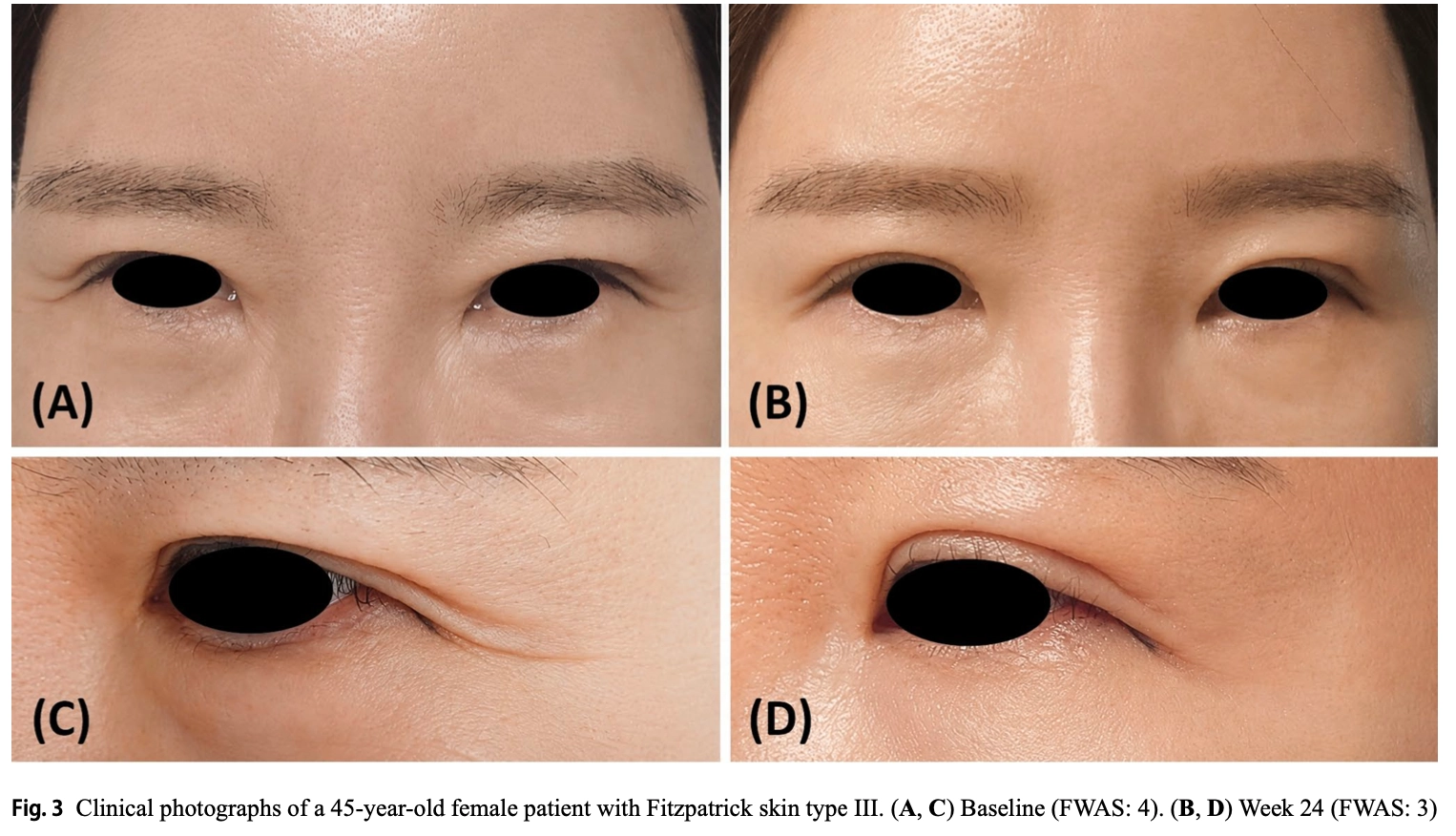
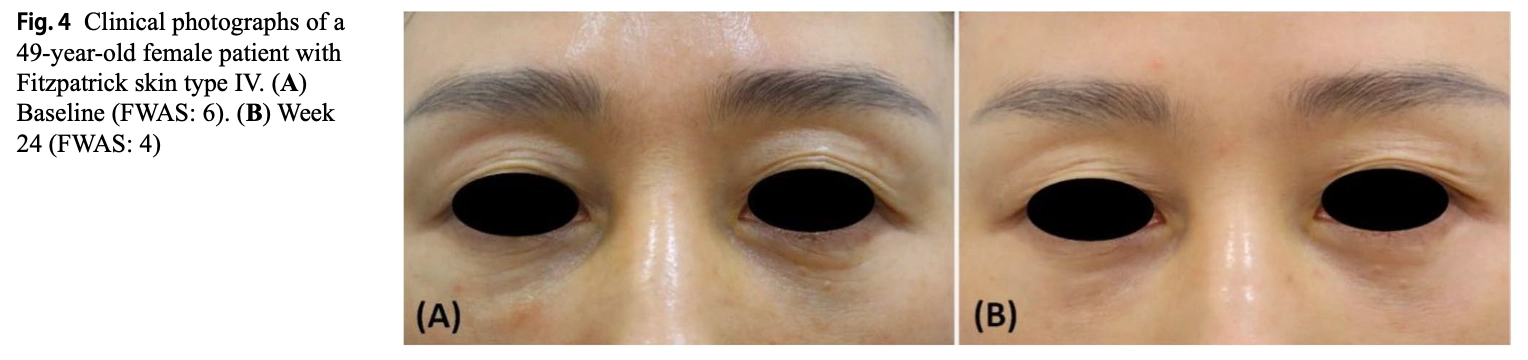
The mean Fitzpatrick Wrinkle Assessment Scale score decreased from 5.44 at baseline to 3.38 at week 24.
Quantitative imaging also demonstrated reductions in average and maximum wrinkle depth, while the measured skin-elasticity parameters progressively improved through the 24-week follow-up.
At week 24, 90.63% of participants reported being satisfied or very satisfied with their treatment results.
The mean bilateral procedure time was approximately 7.2 minutes, with a mean pain score of 3.3 out of 10. Post-treatment reactions were primarily transient erythema and mild edema, with a mean clinical downtime of approximately 1.5 days in the study population.

A Private Clinical Lecture at Éclat de Cheongdam
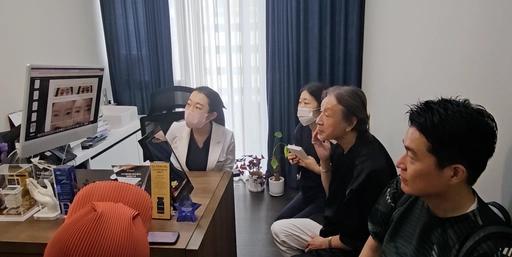
The day began with a short lecture in Dr. Park’s consultation room.
Rather than preparing a formal auditorium-style presentation, Dr. Park reviewed the lecture materials she has accumulated through previous academic meetings and discussed the recently published paper directly with the visiting physicians.
The conversation naturally became highly practical.
How should the parameters change between the eyelid and the cheek?
How should the first and second depths of a Double Shot be selected?
How should emission time, RF level, duty cycle, and vacuum be modified when treating areas with different skin thicknesses?
And how might ELLISYS SENSE be incorporated not only for periorbital rejuvenation, but also for full-face pores, skin texture, neck wrinkles, and tightening?
These are the kinds of details that are difficult to communicate through a paper alone.
The Best Way to Understand a Treatment: Experience It
After the discussion, the seminar moved from theory to hands-on practice.
Dr. Masaki, Dr. Fukuta, and Dr. Tsumiyama experienced ELLISYS SENSE themselves, allowing Dr. Park to demonstrate how she modifies parameters according to anatomy and treatment objective.
The clinical focus included:
Periorbital area— fine wrinkles and tightening
Full face — pores and overall skin texture
Neck — wrinkles and tightening
Importantly, treatment was performed on **one side only**.
This was intentional.
Rather than relying only on an immediate impression, the physicians will be able to observe and compare the treated and untreated sides over time. We are already looking forward to reviewing the differences together at our next meeting.

Parameters Are More Than Numbers
During hands-on education, Dr. Park places particular emphasis on understanding the reason behind each setting.
The eyelid, cheek, and neck differ considerably in skin thickness, curvature, mobility, and underlying anatomy.
For this reason, ELLISYS SENSE is not approached with a single standardized parameter for every region.
Needle depth, RF level, emission duration, duty control, suction, and the depth combination used for Double Shot must all be considered as part of a complete treatment design.
The goal of physician education is therefore not simply to share a numerical setting.
It is to explain why that parameter was chosen for that particular tissue.
From Korea’s Early Clinical Experience to Global Academic Exchange
Dr. So Yoon Park has been working with ELLISYS SENSE since its earliest clinical introduction in Korea and has accumulated extensive experience across a wide range of indications.
Over the years, this experience has been shared through academic lectures, hands-on training, physician education, and international clinical exchange.
The publication of the recent periorbital study represents another important step: transforming accumulated clinical experience into measurable scientific data that can be evaluated and shared internationally.
And perhaps the most rewarding part comes afterward.
A paper is published.
Physicians abroad read it.
Questions arise.
They travel to Seoul.
The discussion moves from a journal page to a consultation room, and eventually to an actual hands-on procedure.
For us, this is what meaningful academic exchange looks like.
A Warm Meeting Beyond Medicine
The visit was academically focused, but it was also a wonderfully warm afternoon.
After discussing parameters and performing the treatments, we took photographs together, exchanged stories, and enjoyed the thoughtful gifts our guests had brought from Japan.
Even the beautifully packaged maple cookies and financiers reflected the charming attention to detail we so often associate with Japan.
We sincerely thank Dr. Nobuyuki Masaki of Masaki Clinic, Dr. Keizo Fukuta of Verite Clinic, and Dr. Shinya Tsumiyama of Verite Clinic Ginza for making the journey to Éclat de Cheongdam Clinic.
It was a privilege to share our clinical experience with such respected colleagues.
And at our next meeting, there will be one particularly interesting question waiting for us:
How did the treated side compare with the untreated side?
We very much look forward to finding out together.

Published Research
Bae KT, Park SY, Park Y, Yi KH.
Dual-depth 25-pin insulated microneedle radiofrequency for moderate-to-severe periorbital wrinkles.*
Lasers in Medical Science. 2026;41:153.
Éclat de Cheongdam Clinic
Dr. So Yoon Park
ELLISYS SENSE Global Key Doctor
4F, Building A, Cheongdam Square
420 Dosan-daero, Gangnam-gu
Seoul, Republic of Korea
Tel. +82-2-6120-8888
WhatsApp +82-10-8899-2903
Instagram@eclatde.usa